
Basit works on the device physics of halide perovskite devices. His research examines what information conventional electrical measurements, such as dark J–V, capacitance–frequency, impedance and current transients, provide about traps and mobile ions in perovskite films, and under which conditions each interpretation is reliable.
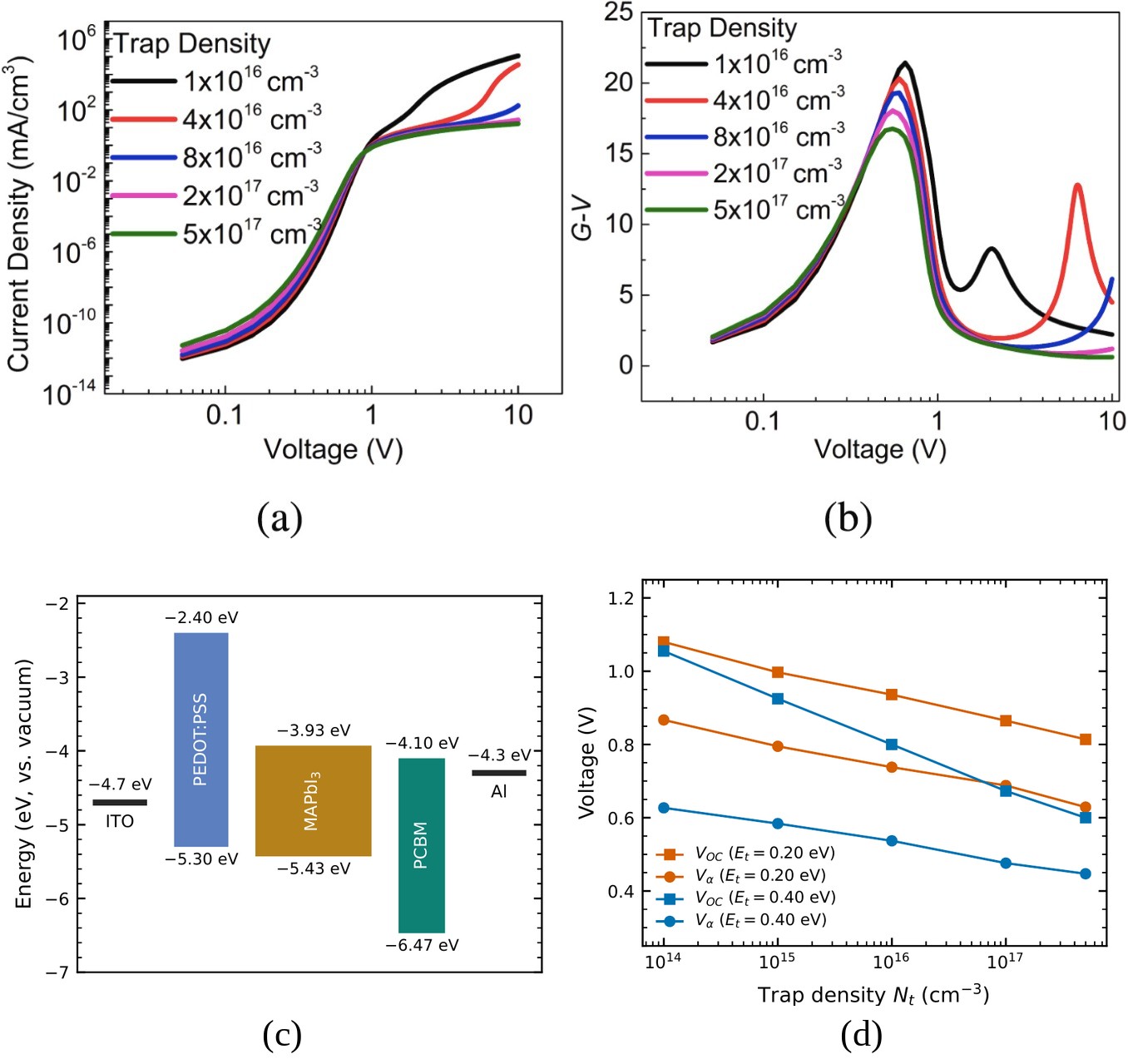
Trap characterisation from dark J–V characteristics. In a perovskite diode, the current changes from diffusion-limited to drift-limited at a transition voltage, which appears as a peak in the logarithmic slope d(log J)/d(log V). Trapped charge near the injecting contact causes band bending and shifts this peak to lower voltages. Using Sentaurus TCAD simulations, he showed that the shift follows trap density and depth, remains applicable in the presence of mobile ions and doping, and is a more sensitive indicator of traps than VOC in complete solar cells. This work was published in Solar Energy (2023). His thesis extends it to a quantitative extraction method.
Slow charge at the contact. His thesis also examines how slow charge near the injecting contact, held either in interface traps or as mobile ions, modifies the injection barrier. He analyses the resulting signatures in impedance and capacitance measurements, including the negative capacitance frequently reported in perovskite devices, and how trap-related and ionic contributions can be distinguished.
CEISIM. For this work he developed CEISIM (Coupled Electronic–Ionic Transport Semiconductor Device Simulator), a one-dimensional drift–diffusion device simulator. It treats trap occupancy and mobile-ion density as dynamical variables and solves DC, small-signal and transient problems within a single framework. Since the internal variables of the device are accessible, individual physical couplings can be disabled one at a time, which, to our knowledge, is not possible in established commercial tools. The simulator has been validated against a commercial TCAD simulator.
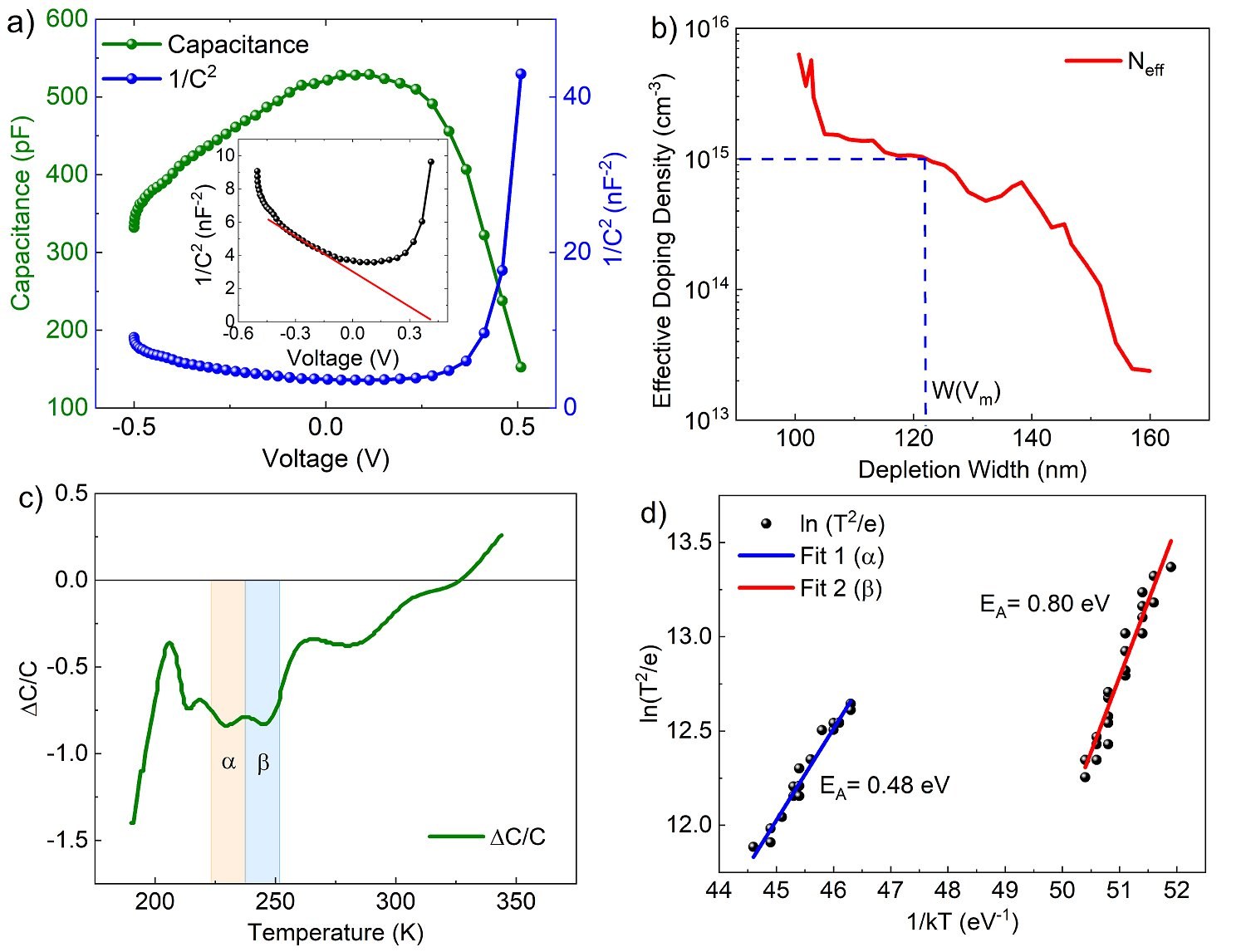
He has also contributed to DLTS studies of ionic defects in flexible perovskite memristors.
Thesis: Electrical characterisation of ionic and electronic defects in halide perovskite devices: a device-simulation study.