

Atanu worked on lead-free tin perovskite solar cells. He combined device fabrication with optical and electrical simulation, and evaluated the environmental impact of each design through life-cycle assessment.
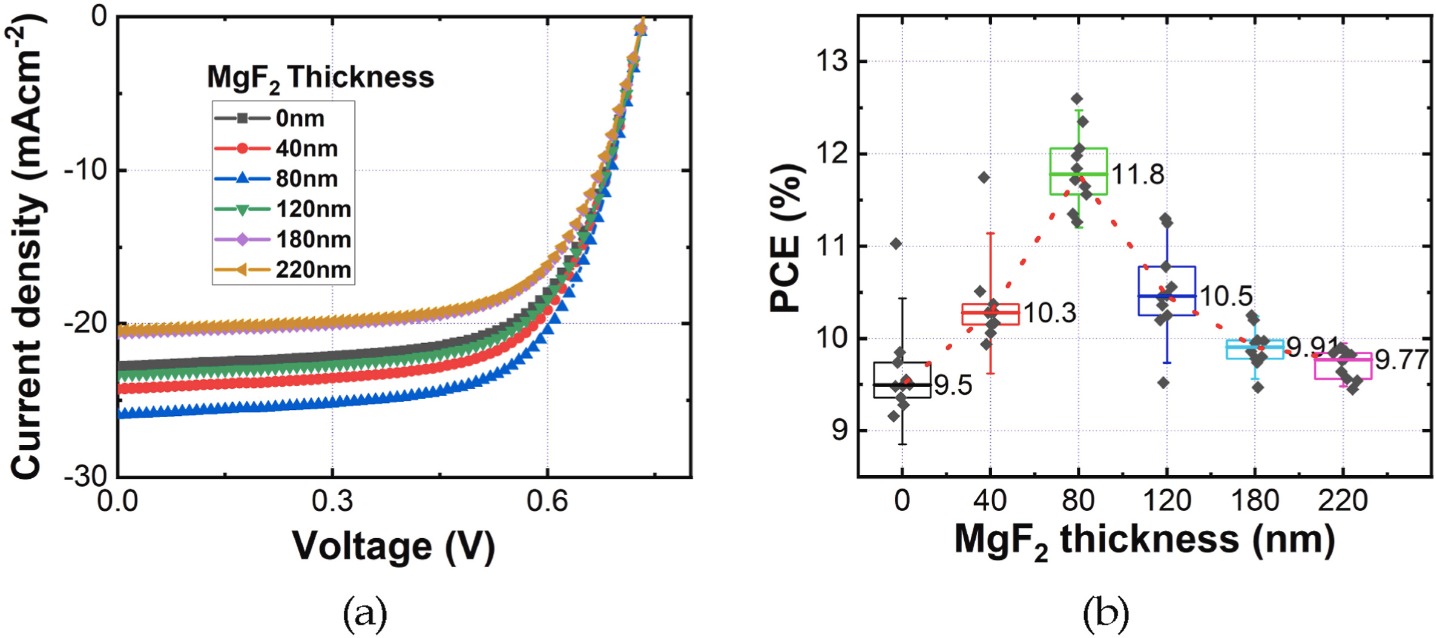
Improved tin perovskite cells. The addition of 15% phenylethylammonium iodide (PEAI) to FASnI₃ forms a mixed 2D/3D film with larger grains and a lower defect density. This increased the efficiency from 6.41% to 11.03%. The 2D/3D cells retained 75% of their initial efficiency after 50 hours, compared with a loss of more than 75% within 16 hours for 3D cells. An 80 nm MgF₂ anti-reflection coating further increased the efficiency to 12.6%.
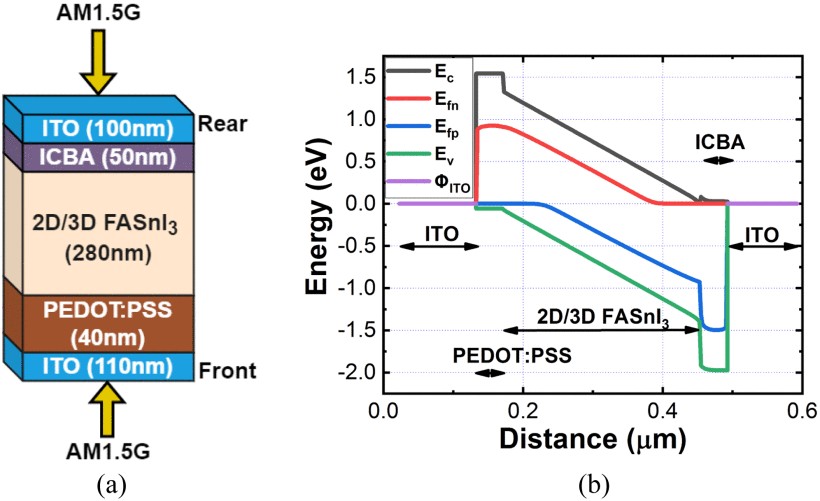
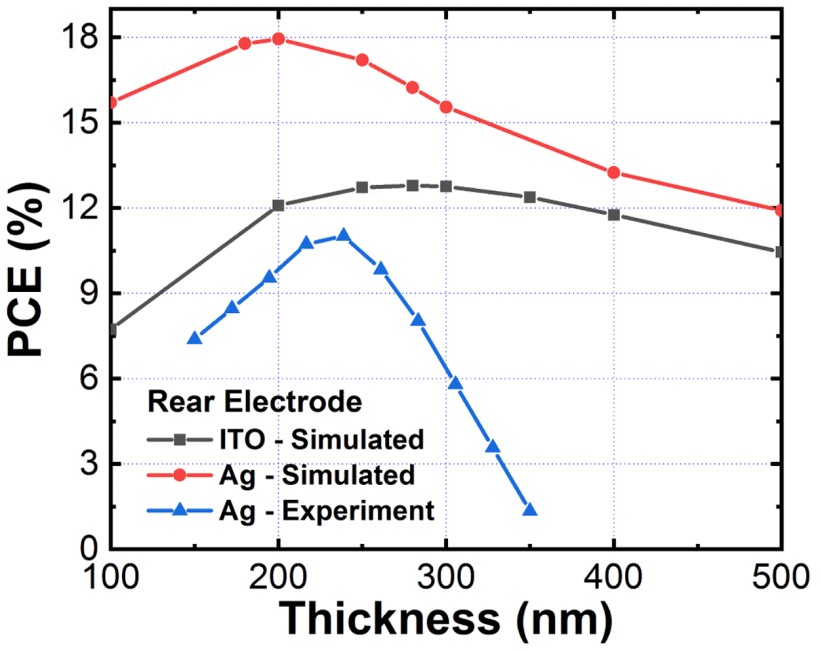
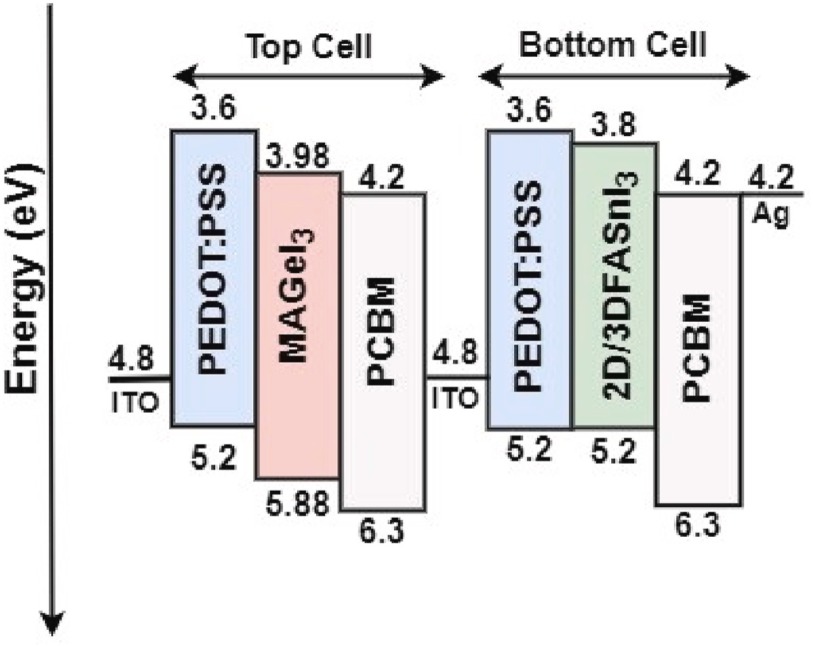
Design of tandem and bifacial cells. He developed transfer-matrix algorithms to optimise the layer thicknesses of tandem and triple-junction cells (software copyright SW-17416/2023). Using these, he identified ITO as the most suitable interlayer for a CsFAPbX₃/FASnI₃ tandem. His lead-free MAGeI₃/2D-3D FASnI₃ tandem design reaches a simulated efficiency of 31.34%. In simulation, a bifacial version of the tin cell gains up to 39% in output power over a snow surface.
Light trapping. In simulation, 10 nm silver nanoparticles at the PCBM/Ag interface increase absorption by about 8%, whereas the same particles in the hole transport layer reduce performance.
Sustainability. His life-cycle assessments estimate an energy payback time of 0.53–0.57 years and emissions of 0.03–0.07 kg CO₂ per kWh for tin perovskite modules. Both values are well below those estimated for lead perovskite and crystalline silicon modules in India.
Research visit to Rice University. As a Mehta Rice Engineering Scholar in 2024, he worked in the group of Prof. Aditya Mohite at Rice University, USA, where he developed synthesis methods for tin perovskite solar cells with a power conversion efficiency of about 14%. Rice Engineering featured his visit in an article in June 2024.
PhD thesis: Efficiency enhancement and sustainability analysis of lead-free hybrid perovskite tandem solar cells