
Lead halide perovskites yield highly efficient solar cells, but lead is toxic. Tin perovskites are lead-free and have a band gap well suited to the bottom cell of a tandem. However, Sn²⁺ is readily oxidised, and the films have a high defect density. We work on improving the performance and stability of tin perovskite cells and use simulation to design tandem and bifacial cells based on them.
Background
Crystalline silicon dominates the present photovoltaic market, and the global installed capacity has exceeded one terawatt. Emerging technologies such as perovskite, organic and quantum-dot solar cells offer properties that are difficult to achieve with silicon. They are lightweight and flexible, and can be printed on plastic or paper by low-cost roll-to-roll processes. This enables applications in wearable electronics, aerospace, building-integrated photovoltaics and indoor cells that power IoT devices under artificial lighting. The main challenges are long-term stability, outdoor durability, sustainable large-scale manufacturing, and further gains in efficiency through tandem architectures and plasmonics.
Our work addresses:
- High-performance, stable absorbers for single-junction and tandem cells
- Flexible, lightweight tandem cells for portable, wearable and building-integrated use
- Linking solar cells with catalytic systems for on-demand green hydrogen (solar-to-fuel)
- Lead-free, environmentally benign materials, with life-cycle assessment to evaluate their sustainability
Key results
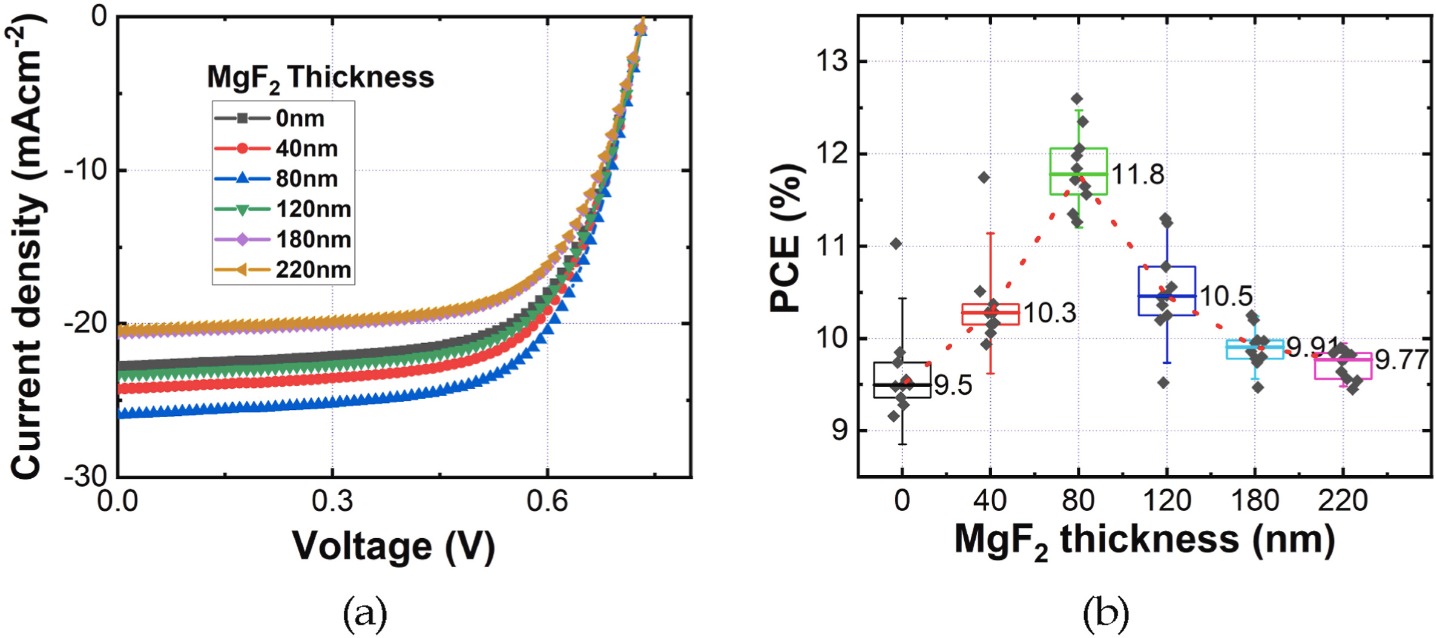
- 2D/3D tin perovskite cells. The addition of 15% PEAI to FASnI₃ increased the efficiency from 6.41% to 11.03%. These cells retained 75% of their initial efficiency after 50 hours, compared with a loss of more than 75% within 16 hours for 3D cells. An 80 nm MgF₂ anti-reflection coating further increased the efficiency to 12.6%.
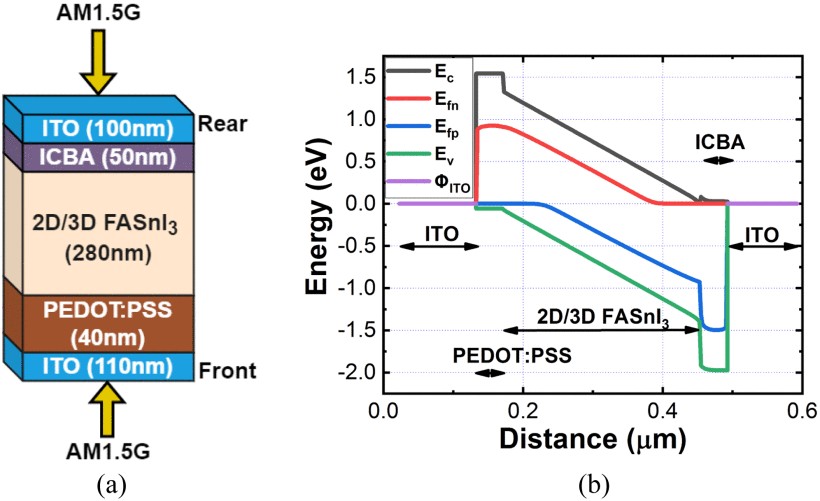
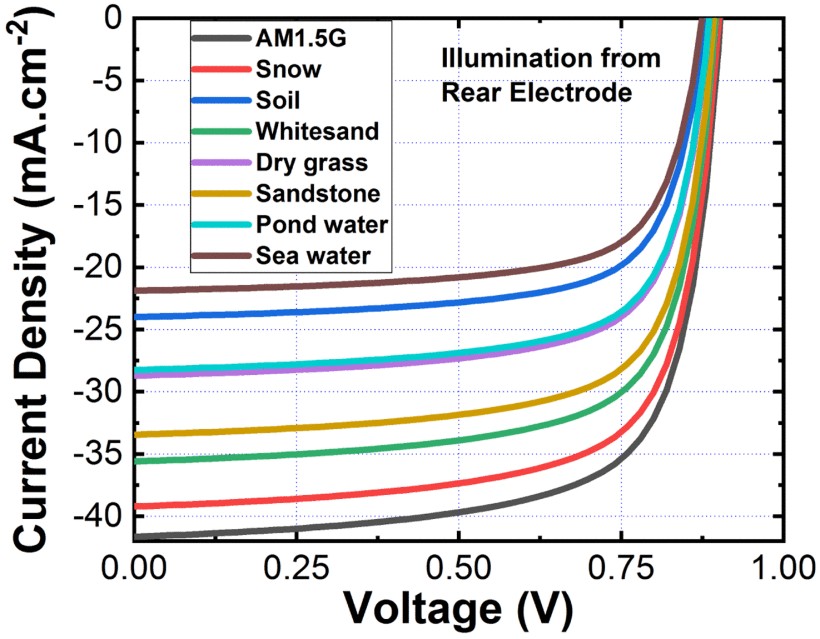
- Bifacial cells. Simulated bifacial 2D/3D tin cells reach 26.55% under illumination from both sides. Over a snow surface, the simulated gain relative to a monofacial cell is 38.85%, whereas over soil or sea water the output is reduced.
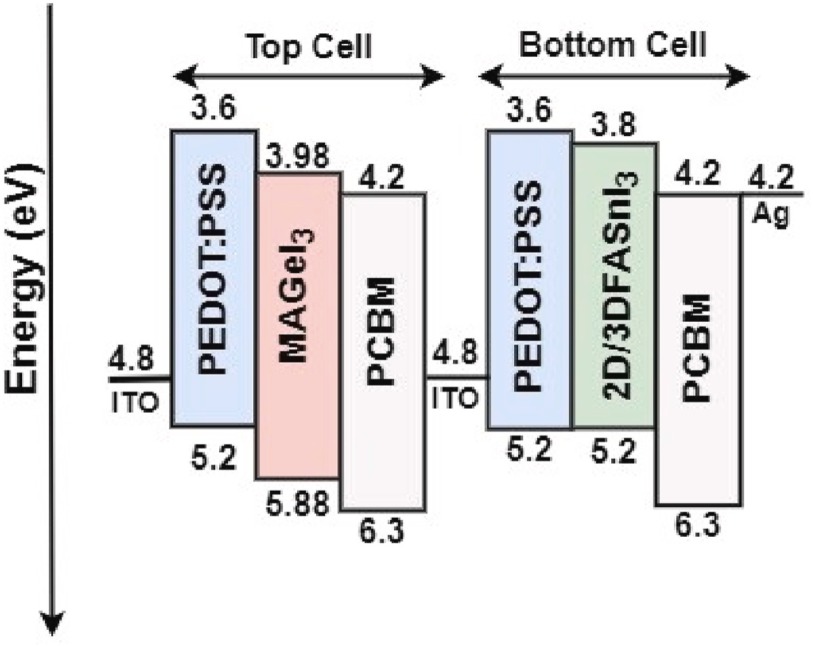
- All-perovskite tandems. A lead-free MAGeI₃ / 2D-3D FASnI₃ two-terminal tandem was designed with a simulated efficiency of 31.34%. Earlier work identified ITO as the most suitable interlayer for a CsFAPbX₃/FASnI₃ tandem and developed transfer-matrix algorithms for tandem and triple-junction design (software copyright SW-17416/2023).
- Plasmonic light trapping. In simulation, 10 nm silver nanoparticles at the PCBM/Ag interface increase absorption by about 8%, giving an efficiency of 23.16%.
- Life-cycle assessment. Tin perovskite modules have an estimated energy payback time of 0.53–0.57 years and emissions of 0.03–0.07 kg CO₂ per kWh. Both values are well below those estimated for lead perovskite and crystalline silicon modules in India.
Award: Best Paper Award, ICAER 2023 (IIT Bombay).
Methods and tools
Spin coating with anti-solvent · spectroscopic ellipsometry · XRD and AFM · J–V and MPP tracking · Silvaco and Sentaurus TCAD · Lumerical FDTD · MATLAB transfer-matrix codes · life-cycle inventory analysis