


Himangshu established the group's research on hybrid perovskite memristors, covering device fabrication, switching physics, measurement methodology, circuit models and defect spectroscopy.
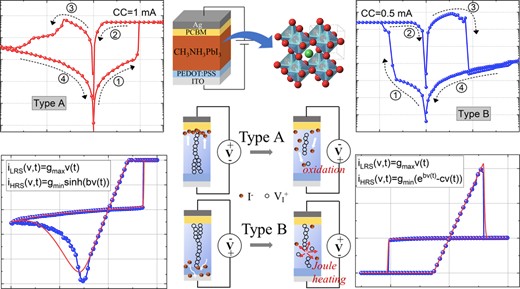
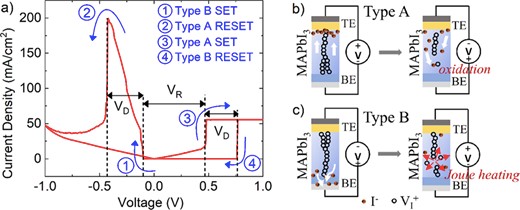
Two switching modes in one cell. In ITO/PEDOT:PSS/MAPbI₃/PCBM/Ag memristors, he found that the compliance current selects between two bipolar switching modes of opposite polarity.
- Type A (1 mA compliance) is a field-driven redox mode of the iodide/iodine-vacancy filament. It sets at 0.47 V, resets gradually at −0.32 V, and gives multilevel states.
- Type B (0.5 mA compliance) resets abruptly by Joule heating, with an ON/OFF ratio near 5,900.
When combined in a single sweep, the two modes give complementary resistive switching in one cell, with a read window of 0.7 V. This can suppress sneak currents in crossbar arrays without a second, anti-serially connected cell. To our knowledge, this was the first report of the effect in a hybrid perovskite memristor. He also identified the conduction mechanism in each state, namely tunnelling in the high-resistance state of Type A, diffusion current in Type B, and Ohmic conduction through the filament in the low-resistance state.
Influence of measurement conditions. He showed that the figures of merit of a perovskite memristor depend strongly on the measurement conditions.
- A higher sweep rate increases the reset voltage and reset current.
- A higher compliance current forms a stronger filament and increases the ON/OFF ratio from 17 to 225.
- A larger device area reduces the forming voltage from 1.55 V to 0.86 V and lowers the high-resistance state, whereas the low-resistance state is determined by the filament alone.
On this basis, he proposed a systematic measurement protocol for perovskite memristors.
Forming and circuit models. In Ge₂Se₃ chalcogenide memristors, he compared five electroforming methods and found that a positive voltage sweep gives the most reproducible subsequent switching. He fitted the perovskite devices with the Yakopcic SPICE model to within about 7%, enabling their use in circuit simulation.
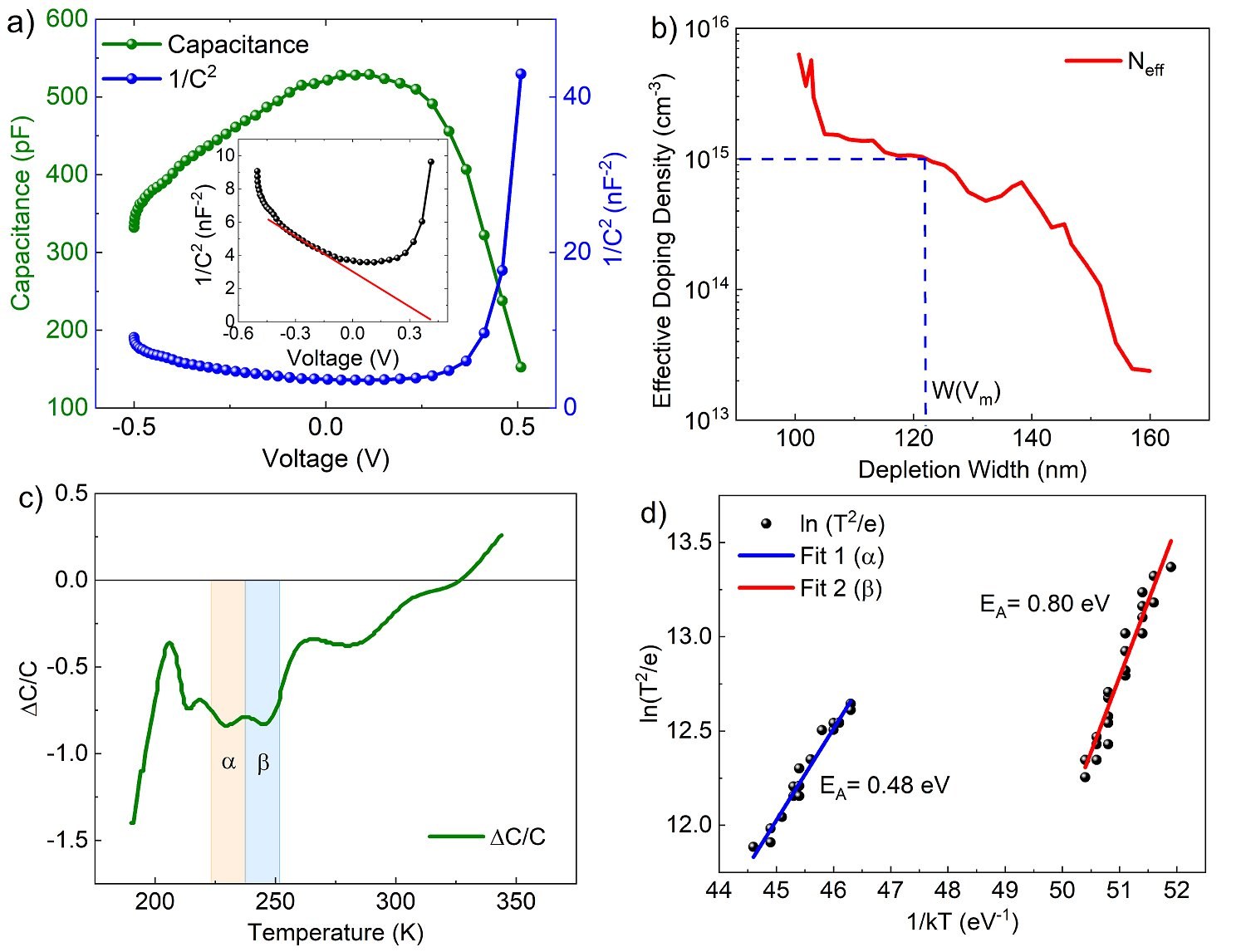
Defects involved in switching. He fabricated flexible perovskite memristors on PET and studied them by temperature-dependent DLTS. This identified methylammonium vacancies with an activation energy of 0.48 eV, which are expected to assist filament formation.
Flexible, lead-free devices. He contributed to the development of the group's flexible, air-stable Cs₃Bi₂I₉ memristors and their use as artificial synapses, and to the study of ion migration in perovskite LEDs.
PhD thesis: Design, optimization and modelling of hybrid organic-inorganic perovskite memristors