

Photo of Radharani Yumlembam

People · Current member

Radharani Yumlembam

PhD Scholar, Electronics and Electrical Engineering

Flexible lead-free perovskite memristors and crossbar arrays

Radharani develops resistive-switching memories (memristors) based on all-inorganic, lead-free perovskites and integrates them into crossbar arrays on flexible substrates. She is co-supervised by Prof. Roy P. Paily, Dept. of EEE.

The devices use Cs₃Bi₂I₉, a bismuth-based perovskite, in a PET/ITO/PEDOT:PSS/Cs₃Bi₂I₉/PCBM/Ag stack. In contrast to most perovskite memristors, the switching layer is deposited by electron-beam evaporation of a hot-pressed pellet, a vacuum process that is scalable to large areas.

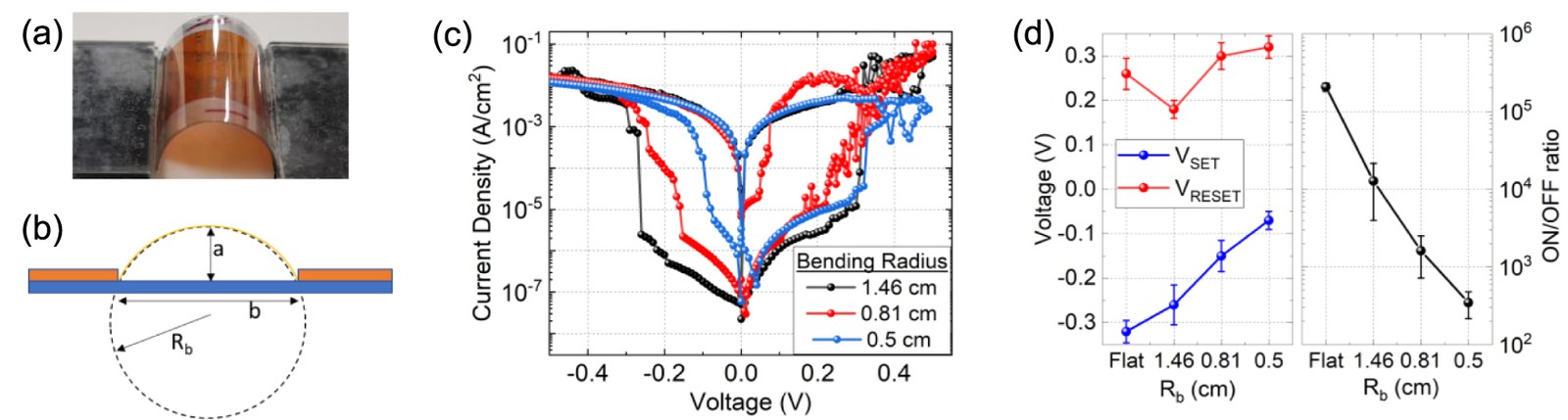
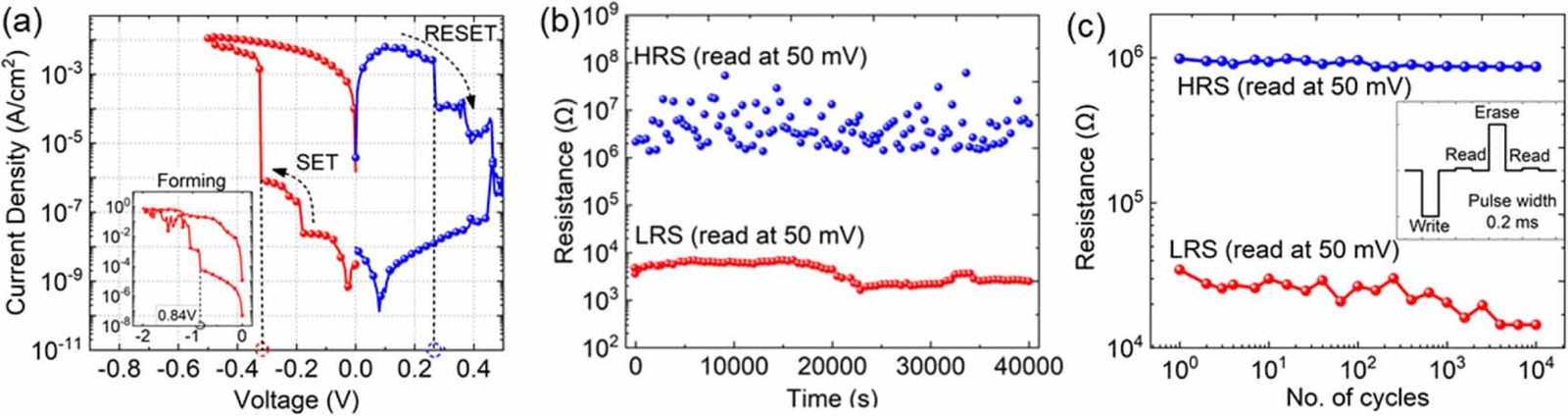
The devices show bipolar switching at low voltages (around ±0.3 V) with an ON/OFF ratio above 10⁵. They remain functional after 30 days at more than 80% relative humidity without encapsulation, and under bending to a 5 mm radius. Conductive AFM indicates that the conducting filament is formed by intrinsic iodine vacancies in the film rather than by silver from the electrode.

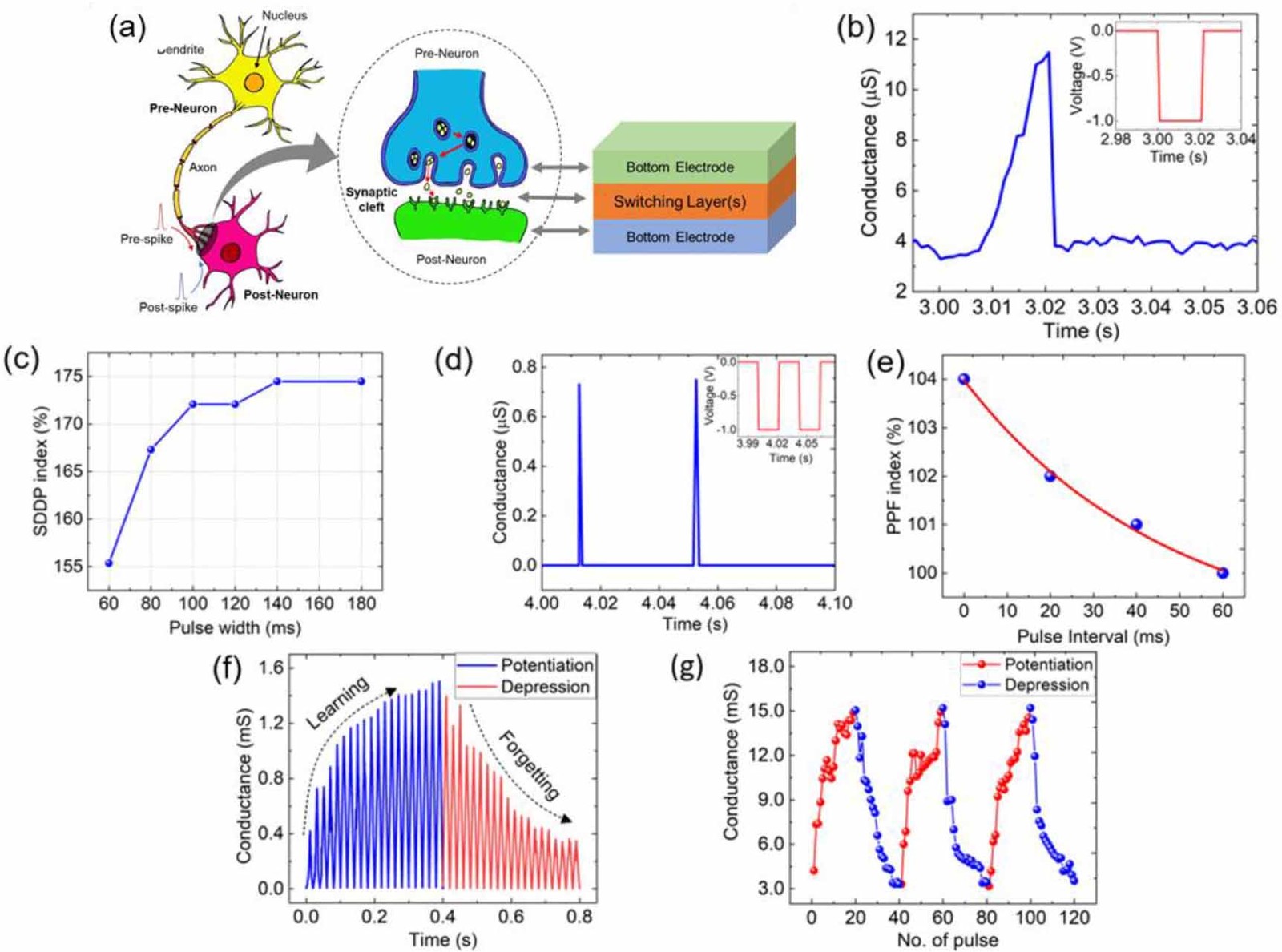
She has fabricated a flexible 4×4 crossbar array with 81% device yield and demonstrated synaptic behaviour, including paired-pulse facilitation and long-term potentiation and depression over 120 pulses, at about 0.1 µJ per event. Her current work addresses larger crossbar arrays based on all-inorganic perovskites.
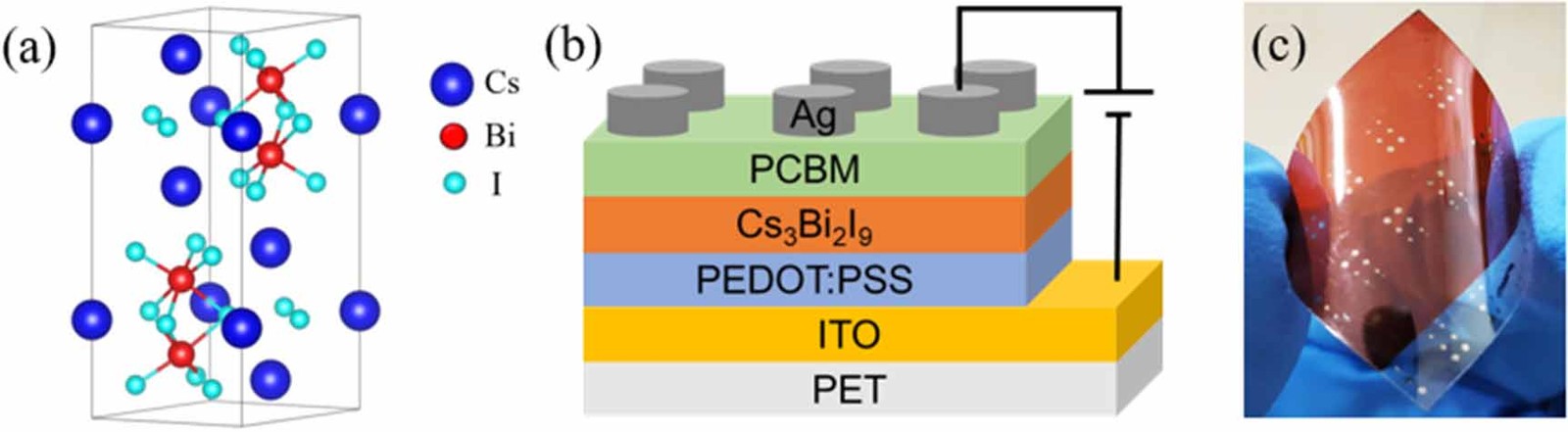
Cs₃Bi₂I₉ crystal structure, device stack on PET and a flexible sample under bending
Cs₃Bi₂I₉ crystal structure, device stack on PET and a flexible sample under bending. From R. Yumlembam et al., Flex. Print. Electron. 10, 015007 (2025).
Bipolar switching, retention and endurance of the flexible memristor
Bipolar switching, retention and endurance of the flexible memristor. From R. Yumlembam et al., Flex. Print. Electron. 10, 015007 (2025).
Synaptic behaviour of the flexible memristor
Synaptic behaviour of the flexible memristor. From R. Yumlembam et al., Flex. Print. Electron. 10, 015007 (2025).
Switching of the flexible memristor at different bending radii
Switching of the flexible memristor at different bending radii. From R. Yumlembam et al., Flex. Print. Electron. 10, 015007 (2025).

Education

  • PhD (ongoing), IIT Guwahati, co-supervised by Prof. Roy P. Paily, Dept. of EEE
  • M.Tech, VLSI and Embedded Systems, NIT Manipur
  • B.Tech, Electronics and Communication Engineering, NIT Manipur

Publications

  1. Artificial synapse using flexible and air-stable Cs₃Bi₂I₉ perovskite memristors R. Yumlembam, H. J. Gogoi, R. P. Palathinkal, A. T. Mallajosyula Flexible and Printed Electronics 10, 015007 (2025) · doi:10.1088/2058-8585/adacf9
  2. Lead-free all-inorganic perovskite memristor by thermal evaporation R. Yumlembam, H. J. Gogoi, R. P. Palathinkal, A. T. Mallajosyula International Conference on Condensed Matter and Device Physics (ICCMDP), Gandhinagar (2023)